Dog dementia signs — what you saw, and what to ask your vet
By Gomi's human — written from 11+ years alongside Gomi (@gomithesuperyorkie), not a vet's office · Last updated October 24, 2026 · about a 10-minute read
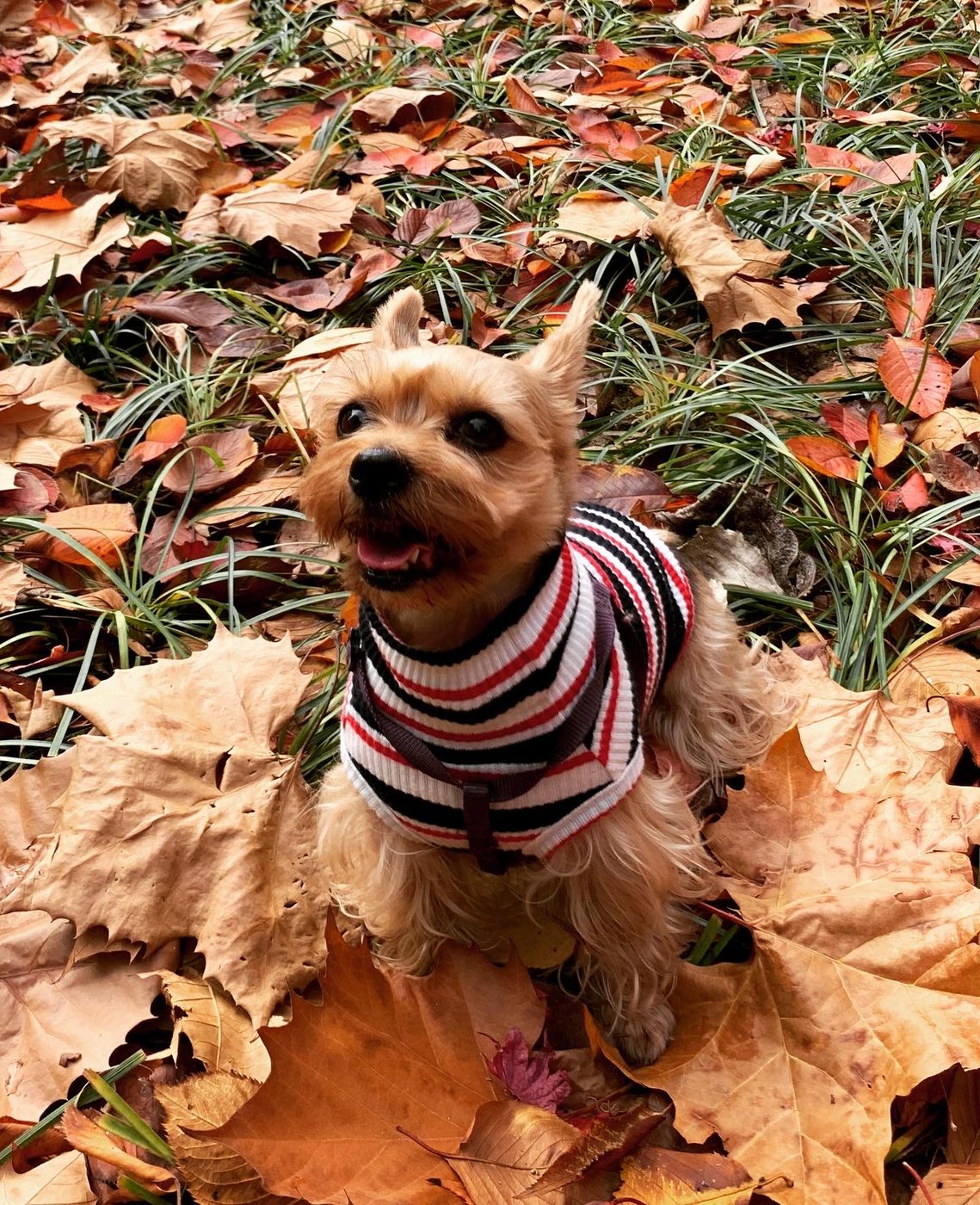
On an early-morning walk by the river, Gomi appeared unable to find me. She looked around, moved in another direction, and returned when I called. Those are observations. They do not tell me whether the cause involved vision, attention, hearing, cognition, or something else. That distinction matters more than the label I first put on a worrying moment.
Part of our complete guide to caring for a senior dog.
If you searched for dog dementia signs, you may have a worrying moment of your own. This article explains six screening categories and how to describe changes to a veterinarian. Sensory problems, pain, and other illnesses can produce overlapping signs or occur alongside cognitive dysfunction; this article cannot rank those explanations for your dog.
Dementia in dogs is a diagnosis of exclusion
A single confused moment or questionnaire score cannot establish canine cognitive dysfunction. A veterinarian needs to assess the pattern and possible alternative or coexisting causes.
The 2023 AAHA Senior Care Guidelines describe cognitive dysfunction as a possible diagnosis of exclusion. Assessment includes the history, physical and neurological examinations, and appropriate laboratory tests. Brain imaging may help assess structural disease; imaging findings still need clinical interpretation.
The point is not to replace one guess with a more reassuring guess. It is to give your vet the information needed to assess sensory problems, pain, organ disease, and cognitive changes together.
The six categories, with observation prompts
DISHAA groups behavior into six areas. The prompts below are examples of what to record, not a completed screening sheet or medical history for Gomi.
D — Disorientation
Getting stuck behind furniture or in corners. Standing on the hinge side of a door waiting for it to open. Staring at walls or into space. Getting lost in the house or the garden. Failing to recognize familiar people or other pets.
What to note: where it happened, the lighting, what your dog did, and how she responded when you called.
I — Interactions
This one moves in both directions and both count. Less interest in approaching you, greeting you, or being stroked. Or the opposite — new irritability, fearfulness, or snappishness with visitors, family, or other animals.
What to note: the specific interaction that changed and when you first noticed it, without assigning a cause such as anxiety or memory loss.
S — Sleep and waking
Pacing and restlessness, particularly at night, changes in waking, nighttime vocalizing, or more daytime sleeping are worth reporting.
What to note: when your dog wakes, what she does, whether she settles again, and whether toileting or other needs have changed.
H — House soiling, learning and memory
Indoor accidents, no longer signaling to be let out, slower responses to familiar commands, or difficulty getting your dog's attention can be useful observations.
What to note: changes in toileting frequency and location, any apparent discomfort, and the circumstances in which a familiar cue gets a different response.
A — Activity
Less exploring, less play, less interest in things she used to seek out. Or aimless activity replacing purposeful activity — circling, repetitive licking or chewing, staring at nothing.
What to note: which activities changed and whether movement itself looks difficult.
A — Anxiety
New or worse separation distress. Bigger reactions to noises and sights that never used to bother her. More fear of unfamiliar places or of going out at all.
What to note: the trigger, the behavior you saw, its duration, and what helped your dog settle.
What the river incident does and does not tell me
The observation is that Gomi appeared unable to find me in low light and returned after I called. My thought that the lighting or her eyes might have played a part is a hypothesis, not a veterinary finding.
Gomi receives ongoing veterinarian-guided eye care, but a cloudy-looking eye does not establish the cause of that incident. The American College of Veterinary Ophthalmologists explains that nuclear sclerosis is not generally considered to cause significant vision impairment. It would therefore be wrong to use cloudiness alone to label this a vision problem, or to say it was not a memory problem.
In the Dog Aging Project's 15,019-dog study, a history of neurological, eye, or ear disorders was associated with higher odds of cognitive dysfunction after adjustment for other characteristics. That finding supports assessing overlapping problems; it does not explain what happened to Gomi by the river.
These are associations, not proof that sensory loss causes cognitive decline or that a particular behavior has a sensory cause. Owner-reported behaviors can overlap across conditions, and sensory impairment and cognitive dysfunction can coexist. A screening score needs clinical interpretation.
Possible explanations to discuss, not diagnoses
- Difficulty finding a familiar person — record lighting, surroundings, and the response to a voice. Vision, hearing, attention, cognition, and other factors may need assessment. Our eye-care guide explains why appearance alone does not establish visual ability.
- Night pacing and daytime sleeping — pain is the classic mimic here. Dogs who cannot get comfortable get up, turn, lie down, get up again, and then catch up on sleep during the day. That is the whole subject of the seven subtle signs of pain. Full bladder, needing to go out more at night, and simple sleep-cycle drift also live here.
- Missing the pee pad — this is the one I would want checked properly. Urinary tract infection, kidney disease, endocrine disease and pain all cause it, and so does not being able to see the edge of a pad clearly in a dim hallway. It is also the one owners are most likely to write off as naughtiness.
- New clinginess — anxiety, discomfort, or reduced confidence in a dog who can no longer track where you are by sight. Being more affectionate is the pleasantest possible symptom, which is why it never gets reported.
Nothing here confirms or excludes cognitive dysfunction in Gomi. Take your own dated observations to the vet, including what has not changed. These possible explanations are not a record of diagnoses, test results, or appointments for her.
What is actually known about who gets it
Two numbers from the same 15,019-dog cohort are worth carrying around.
The first is age. In the adjusted analysis, each additional year of age was associated with 52% higher odds of cognitive dysfunction. That is an association in this sample, not an individual dog's probability of developing it.
The second is activity. In the adjusted analysis, inactive dogs had 6.47 times the odds of cognitive dysfunction compared with very active dogs. A separate 11,574-dog study also found higher reported activity associated with lower odds of reaching its cognitive dysfunction threshold.
These observational findings do not establish that exercise prevents dementia. Reverse causation is possible: dogs whose cognition or health is declining may become less active. An appropriate activity plan belongs in a conversation about your own dog's comfort, health, and abilities.
What I would say is narrower and still worth acting on. An active, mentally engaged old dog is a better outcome by every measure we can actually observe, whichever direction the arrow runs. AAHA's own management advice pairs diet with environmental enrichment — exercise, new toys, cognitive games, tasks. If you want the encouraging version of that, the learning research is genuinely good news: an old dog can still learn new things, and teaching her something is the cheapest enrichment there is.
Build the record before the appointment
Every sign in this article is a change from a baseline. If you cannot describe the baseline, the vet is working from adjectives.
- Score the DISHAA sheet today, even if everything is normal. A zero from this year is worth a great deal next year.
- Date the changes. "Since roughly May" is enormously more useful than "recently." Slope matters more than any single score.
- Film thirty seconds of the night behavior if there is any. Nobody describes pacing accurately from memory, and your vet will never see it in the consult room.
- Describe the circumstances, not a home diagnosis. Note lighting, surroundings, distance, and responses to familiar voices during ordinary, safe activities. Do not deliberately place your dog in darkness or let her off leash to test whether she becomes confused.
- Write down what has not changed. An unchanged list is diagnostic information too, and it is the part everyone forgets to mention.
- Ask for the urinalysis if there are any house-soiling changes. Do not let that one get filed under behavior.
Our 90-day memory and care journal has dated daily pages built for exactly this kind of slow-change tracking, and the free Tiny Changes checklist is a shorter place to start tonight. AAHA recommends a medical workup for senior pets once or twice a year including blood work and urinalysis — if you already have that appointment booked, the observations above are what make it count.
And if the reason you are reading this at midnight is that you are frightened of what is coming rather than dealing with something today, the longer story behind this site is closer to what you actually want.
Frequently asked questions
What are the first signs of dementia in dogs?
Usually a changed night — more pacing, more waking, less settling — with more daytime sleeping alongside it. Disorientation, changed social behavior, house soiling, changed activity and new anxiety fill out the six screening categories. One sign in isolation rarely means much; several categories moving together is what starts a veterinary conversation.
How is canine cognitive dysfunction diagnosed?
A veterinarian assesses the history, physical and neurological examinations, and appropriate tests for other causes. AAHA describes cognitive dysfunction as a possible diagnosis of exclusion; brain imaging may help assess structural disease. Neither one incident nor an owner questionnaire establishes the diagnosis.
Is it dementia or is she going blind or deaf?
You cannot distinguish cognitive dysfunction from sensory or other medical problems using a home questionnaire alone, and these conditions can coexist. Record the circumstances and changes from your dog's usual behavior. Cloudy-looking eyes do not by themselves establish vision loss or explain a confused moment; ask your vet to assess it.
Is there a home test for dog dementia?
There is a free scoring sheet, which is not the same thing. The DISHAA Assessment Tool rates six categories from 0 to 3; 4 to 15 is mild, 16 to 33 moderate, above 33 severe. Use it to track change over time, not to reach a conclusion.
Does keeping my dog active prevent dementia?
The link is strong — odds of cognitive dysfunction were 6.47 times higher in inactive dogs than very active ones in a 15,019-dog cohort — but the researchers explicitly cannot rule out that declining dogs simply move less. Keep her active anyway; the case for it does not depend on this question being settled.