Senior dog eyes — cloudy, weepy, or just older?
By Gomi's human — written from 11+ years alongside Gomi (@gomithesuperyorkie), not a vet's office · Last updated: October 24, 2026 · about an 8-minute read
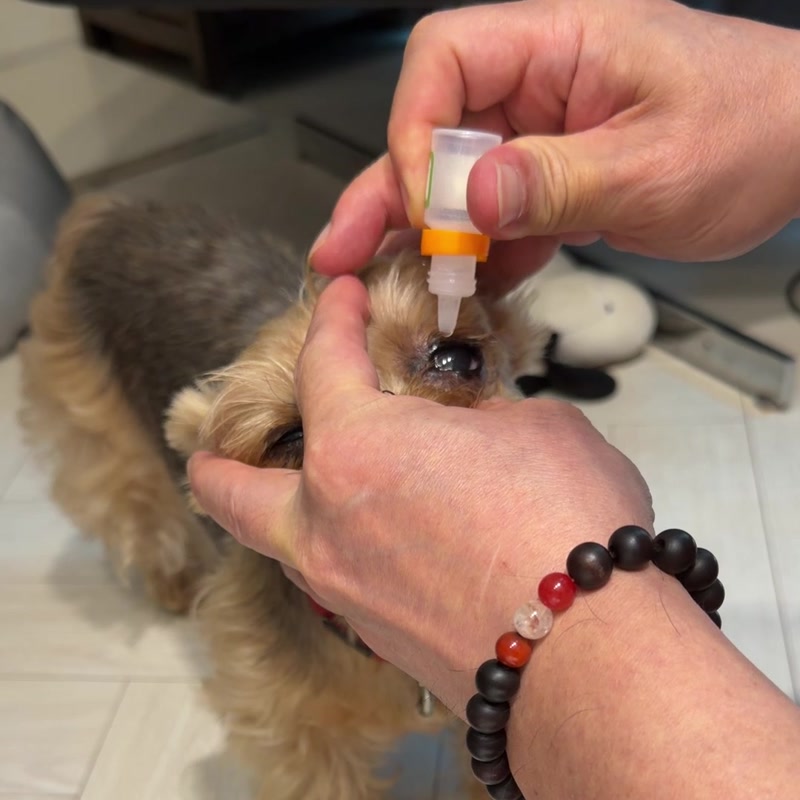
Eye care is part of Gomi's daily routine, under her veterinarian's direction. I check for bleeding and changes in discharge, and we return sooner if something looks different or worse. What I can observe at home is not the same as knowing the diagnosis or deciding which treatment to change.
Part of our complete guide to caring for a senior dog.
Persistent redness needs reassessment, not a home diagnosis
If an eye is not improving, tell your veterinarian what has changed and ask whether another examination or an ophthalmology referral is appropriate. Do not assume that redness identifies the cause or continue changing products on your own.
Different conditions can produce overlapping signs. For example, the Merck Veterinary Manual describes tearing, inflammation, and corneal injury with eyeworm disease. That is background information about one possible condition, not a diagnosis or a documented treatment history for Gomi.
"Cloudy" is three different things
A cloudy-looking eye can involve the lens or the surface of the eye. Similar appearances can have different causes and need different care. Three possibilities a veterinarian may distinguish are:
- Nuclear sclerosis — an age change inside the lens, where the fibers compress over time. The American College of Veterinary Ophthalmologists notes it is often seen after 8 to 10 years of age and "is not thought to cause any significant vision impairment in our pets." It looks like a faint blue-gray haze deep in the eye. Nothing reverses it, and for most dogs nothing needs to.
- A cataract — a true opacity of the lens, which can be inherited, metabolic (diabetes is a common driver), traumatic, or age-related. A mature cataract affects the whole lens and causes real vision loss. This one matters, and it is the one worth catching early.
- Something on the cornea — the clear window at the front. Swelling, scarring, pigment, or an ulcer all read as white or gray to the naked eye. Unlike the lens changes, corneal problems often do respond to treatment, which means they can get better and they can get worse.
They look similar from where you are standing, and ACVO is blunt that telling them apart takes a proper ophthalmic exam, usually with the pupil dilated. You cannot do it from the sofa and neither can I.
Cloudiness alone does not establish how well a dog can see. In particular, nuclear sclerosis should not be used by itself to explain a dog losing track of a person in low light. An observed change in appearance, a possible explanation, and a veterinarian's diagnosis are three different things.
What the daily drops are actually for
Gomi has ongoing eye care, with the treatment and medication schedule set by her veterinarian. Depending on her condition, we return roughly every two weeks so the vet can examine her and tell us what to do next. That interval is for her existing eye problem, not a recommended check-up interval for every senior dog.
At home, I check for bleeding and the amount of eye discharge every day while caring for her eyes. I compare what I see with her own usual condition. If it looks different or worse, I take her back to the veterinarian even if two weeks have not passed. Daily observation supports the vet's care; it does not tell me which medicine to change or whether to skip a dose.
Cleaning and lubrication have a different role from addressing a lens change. Cornell's dry-eye guidance describes thick discharge, redness, and squinting among the signs of tear-film problems. A veterinarian uses an examination and tests such as tear measurement to assess the cause and choose treatment. This is not a diagnosis of every dog with discharge, or a reason to copy Gomi's medicines.
The useful distinction for me is between carrying out the prescribed care and judging whether her condition has changed. I do the daily care and observations; the veterinarian decides what those changes mean and whether the plan needs adjusting.
How to give a dog eye drops without a wrestling match
What the existing photo shows — and what it does not
In the photo above, one hand supports Gomi's head and the other holds the bottle above the eye. The image does not show the bottle label, the full setup, how much was given, or what happened afterward. It cannot establish tip clearance throughout the movement. Ask your vet to demonstrate a comfortable, safe hold for your dog; do not copy a still image as a complete procedure.
The general guidance below comes from veterinary sources, not a filmed step-by-step session with Gomi. Her product, dose, order, and schedule remain the veterinarian's instructions.
- Clean first. VCA suggests gently clearing debris from around the eye with warm water and a washcloth before anything goes in. Wipe from the inner corner outward, and use a fresh area of cloth for the second eye.
- Come from behind, not from the front. A bottle descending toward a dog's face is alarming. Standing beside or slightly behind her, with her head steadied from underneath, is not.
- Ask your vet to demonstrate hand support. VCA describes resting the bottle hand against the head to reduce movement. A still photo cannot show whether a hold is safe for your dog or whether the tip stays clear throughout the procedure.
- Pull the lower lid down slightly and aim for the inner corner. Cornell's guidance is to squeeze the drop into the inner corner and then hold the head up for a moment so it spreads across the surface.
- Never let the tip touch anything. Not the eye, not the lids, not the fur, not the counter. Cornell adds that with ointment you should point the tube tip away from the eye, so a sudden jerk cannot drive it into the surface, and lay the ribbon along the inside of the lower lid instead.
- Ask about order and spacing. If your dog is on more than one product, ask your vet which goes first and how long to leave between them. It matters, and the answer depends on what you have been given, so I am not going to invent a number here.
Reward-based practice to discuss with your vet
Gomi stays still with the eye wash we currently use; with an earlier wash she would turn her head away. That is an observation from our routine, not proof that a particular training method or product caused the difference.
The 2015 AAHA Canine and Feline Behavior Management Guidelines describe gradual exposure and rewards as ways to change an animal's response to handling. The suggestions below are general practice ideas to discuss with your vet, not a recorded reward sequence or training outcome for Gomi.
Possible practice steps, separate from prescribed medication:
- Same place, same order, every time. Predictability does a lot of the work.
- Reward comfortable handling. Ask your vet how to introduce brief handling practice without giving extra medication or putting a painful eye under pressure.
- Choose an appropriate reward. Ask which treat or other reward fits your dog's diet and health needs.
- Keep practice short; keep medication on the prescribed schedule. End a handling practice session before she becomes distressed. If you cannot give a prescribed dose safely, contact your vet for help rather than skipping it or changing the schedule yourself.
- Get help if handling is difficult. Do not force your dog to tolerate a hold that is painful or unsafe.
What to watch for between visits
Eyes change slowly, and slow changes are the ones you stop seeing because you look at them every day. The things worth writing down are these:
- Discharge that changes character — clear to thick, or yellow-green.
- Tear staining appearing or getting worse on one side.
- Squinting, blinking more, or holding one eye slightly closed.
- Pawing at the face or rubbing along furniture and carpet.
- New haze, especially if it looks like it sits on the front surface rather than deep inside.
- Bumping into things in dim light, or new hesitation on stairs and in unfamiliar rooms.
- A change in how the eyes look in photos — note lighting differences and do not use a photo to diagnose cloudiness or delay care.
If nighttime confusion is part of the picture, do not assume it is caused by the eyes. Our cognitive-change guide separates observations from possible explanations, and the senior dog signs checklist covers other changes to report. Changes in chewing, appetite, or breath also deserve their own assessment; our dental guide explains why smell alone cannot establish dental health.
For a proper record, our 90-day memory and care journal has daily pages built for exactly this kind of small-change noticing, and the free Tiny Changes checklist is a shorter place to start tonight. If you want a rough sense of where your dog sits on the aging curve, the dog age calculator takes a few seconds. And the longer story of why I started writing any of this down is here.
A daily eye note you can bring to the vet
Prefer a ready-to-copy page? Make a one-page vet summary using your own observations. Nothing is diagnosed or scored.
Copy these prompts into any notebook. They are observation fields, not a diagnostic score. Do not wait to fill a week of notes if the eye is painful, bleeding, or suddenly different.
| What to record | Your note |
|---|---|
| Date, time, and eye | Which eye? Before or after the prescribed care? |
| Bleeding and discharge | Any bleeding? Amount and appearance of discharge compared with usual? |
| Comfort and appearance | Squinting, rubbing, redness, cloudiness, or a new change? |
| Care and follow-up | Care given as directed, any difficulty, and when you contacted the vet. |
Frequently asked questions
My senior dog's eyes look cloudy. Is it cataracts?
Cloudiness can involve the lens or the surface of the eye. ACVO explains that nuclear sclerosis is not generally considered to cause significant vision impairment, while cataracts can affect sight. Appearance alone cannot distinguish the conditions, establish visual ability, or explain a confused moment. Your vet needs to examine the eye.
Can drops clear a cloudy lens?
Do not assume an eye product will clear lens cloudiness. A veterinarian needs to distinguish a lens change from a surface problem and explain what the prescribed medicine is treating. Cleaning or lubrication is not a substitute for that examination.
How often should an older dog's eyes be checked?
Include the eyes in routine senior examinations, and let your vet set follow-ups for any existing eye condition. Gomi goes back roughly every two weeks depending on her condition, or earlier if daily checks show a change. That is her individual plan, not a general interval. New pain, bleeding, or sudden vision changes should not wait for a scheduled check.
Is it normal for an old dog to have more eye discharge?
Common, but not something to file under normal without a look. Persistent thick or yellow-green discharge is one of the signs Cornell lists for dry eye, which is diagnosed with a simple tear test and managed for life. It is an easy thing to test for and a bad thing to ignore.