Is my senior dog sleeping too much? Why counting hours misses it
By Gomi's human — written from 11+ years alongside Gomi (@gomithesuperyorkie), not a vet's office · Last updated: September 30, 2026 · about a 9-minute read
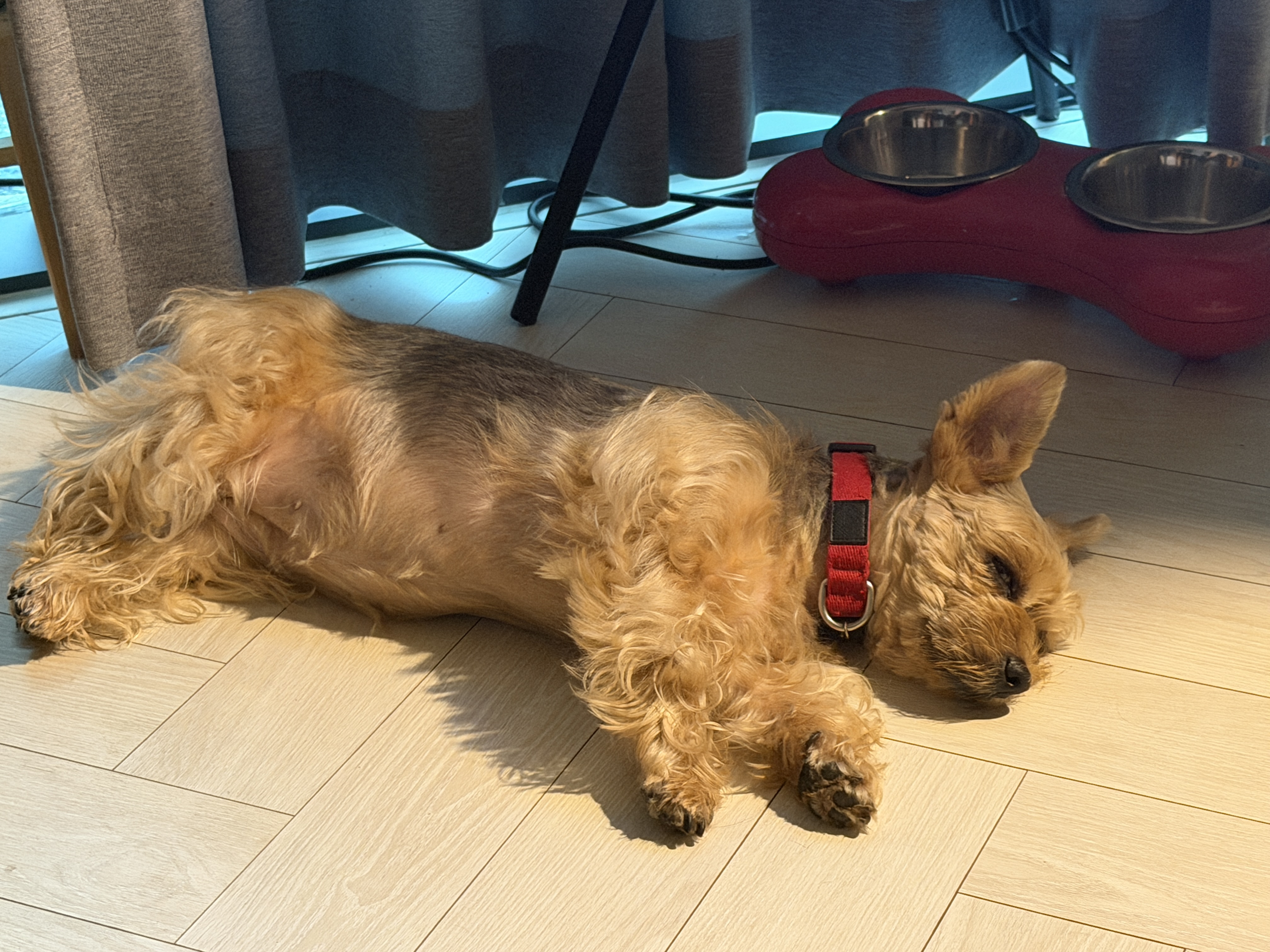
You look over at your dog on the floor and something small snags. She is down again. She was down an hour ago. Was it always this much, or is this new? A sleep estimate can start that conversation, but it cannot answer it alone. This guide adds observations you can describe to your vet.
Part of our complete guide to caring for a senior dog.
A sleep total is not a diagnosis
A quoted daily sleep range cannot tell you whether a change is normal for your particular dog. An estimate of hours can be part of your notes, but how she settles, wakes, and behaves when awake adds important context.
In 2023 a team at North Carolina State University published the validation of SNoRE 3.0, an owner-completed questionnaire for measuring sleep in dogs. Building it meant testing which questions actually carried information. Their draft included one asking how frequently the dog napped during the day. It did not load onto either of the factors the analysis found, and it was cut from the final version. The authors' stated reason was that many owners simply are not observing their dogs during the day, and so cannot answer that question accurately.
That is a limitation of one owner-reported question, not proof that sleep duration cannot be measured or that every sleep estimate is useless. It is a reason to be clear about what you actually observed and what you could not see.
Ask your vet about a change from your dog's own routine rather than treating an online number as a diagnostic threshold.
Lying down is not sleeping
Here is where it gets genuinely surprising. As part of the same validation work, thirty-eight dogs were wired for polysomnography — the full setup with brain activity, eye movement and muscle tone — during a two-hour afternoon nap.
Across those recordings, median wakefulness was about 52%, drowsiness 21%, non-REM sleep 19%, and REM about 2%; median sleep efficiency was roughly 22%. These are separately calculated medians, not one dog's complete sleep profile, so they need not sum to 100%.
Those figures describe a two-hour laboratory afternoon recording, not a typical full day at home. They show why resting and measured sleep are not interchangeable, not how much your dog should sleep.
From across the room, I cannot reliably separate quiet rest from sleep. With Gomi, the observation I can stand behind is that she stays down longer between activities. That is still worth describing to her vet; calling it rest rather than sleep does not make a new reduction in activity harmless.
Those are two different observations, and only one of them is about sleep.
What genuinely changes: the shape, not the total
Sleep does change with age in dogs, and the change has a specific character that is much more useful to know than a total.
The clearest picture comes from a 2002 study in Behavioural Brain Research by Takeuchi and Harada, who implanted telemetry devices and recorded brain activity, muscle activity and heart rhythm continuously across a full 24 hours in aged dogs and young dogs. Three findings stand out.
- Daytime deep sleep went up. The older dogs spent significantly more of the daylight hours in slow wave sleep.
- Night-time wakefulness went up. They tended to spend more of the dark hours awake.
- The daytime pattern fragmented. The young dogs showed one clean sleep peak in the early afternoon. The older dogs' daytime sleep broke into scattered peaks instead of a single nap.
REM sleep, which the paper calls paradoxical sleep, dropped sharply in the older group — not only in total time but in the number of episodes, which fell to roughly a third of the young dogs' count overnight. The authors' interpretation was that the aged dogs had lost some of their capacity to sleep through the night, and that the daytime sleeping was compensating for what the night no longer delivered.
One important caveat: this was four dogs in each group, in a laboratory. It suggests that timing and fragmentation matter, but does not establish a universal pattern for senior pets. A larger total, disrupted nights, or reduced activity when awake can each be worth discussing with your vet.
Sleeping more and sleeping well are not the same
The instinct is to assume that a dog who is asleep a lot is at least sleeping deeply. The evidence points the other way, and this is the finding that changed how I look at Gomi on the floor.
A 2023 polysomnography study in Frontiers in Veterinary Science recorded twenty-eight senior dogs, aged roughly ten to sixteen, during an afternoon nap and compared their sleep against cognitive testing and a validated dementia questionnaire. Dogs with higher dementia scores spent less time in both non-REM and REM sleep, not more. They also took longer to drop into non-REM in the first place. Dogs who did worse on a problem-solving task showed the same pattern: more time awake, less time asleep, longer to get there.
These were associations in a small study, not a way to diagnose dementia from a nap. Settling and night waking are useful observations to report; they do not identify the cause by themselves.
The same paper is honest about its own limits — the recordings were afternoon naps, not nights, and nobody knows for certain how well that maps onto overnight sleep. But it is enough to retire the idea that more sleep automatically means worse.
What to watch instead of the clock
The questions that survived the SNoRE validation are a good map of what is actually worth noticing, because they are the ones that carried real information. Two of them concern how well she sleeps and two concern what interrupts it.
- How easily she settles at bedtime. Not whether she sleeps, but how long the run-up takes. Longer settling was the measure that correlated most strongly with objective sleep quality.
- Whether she stays down through the night, or surfaces repeatedly. Dogs with worse questionnaire scores were measurably more active between roughly 1 and 3 in the morning.
- Whether she is getting up at night to urinate. A physical reason for waking, and a specific one to report.
- Whether her breathing pauses or changes while she sleeps.
- Whether twitching or vocalising actually wakes her. Dreaming itself is normal — and worth noting, the study found no relationship at all between how much owners thought their dog dreamed and how much REM sleep she was measured to have. The question that matters is whether the movement breaks the sleep, not whether it happens.
One practical note from the authors: because different people judge the same dog differently, whoever does the observing should keep doing it. Consistency in the observer matters more than precision.
Breathing-rate monitoring: agree a plan with your vet
Breathing rate during quiet rest or sleep can be useful, especially when your vet has recommended monitoring a heart condition. It is not a substitute for assessing a new sleep or activity change.
VCA's home breathing-rate guidance describes 15–30 breaths per minute during calm rest or sleep. Ask your vet to show you how to count and set a plan for your dog, including when to call. Panting, activity, and distress are different contexts.
Do not diagnose heart disease from a single count or treat a number in that range as proof that everything is fine. A repeated increase from the usual rate warrants veterinary advice; difficulty breathing needs emergency care without waiting to recount.
Mitral valve disease is common in aging small dogs, though only a minority ever progress to heart failure, and many older dogs with it are not limited by it. Early signs owners notice are shortness of breath, tiring easily and coughing. This is precisely the kind of thing that hides underneath "she is just slowing down."
Four things that are not aging
Sleeping more is not a diagnosis, and the reason to take it seriously is that it is a plausible early face of several treatable things. None of these is sorted out at home.
Thyroid. Lethargy, dullness and reduced activity are among the most commonly reported signs of canine hypothyroidism. AAHA's 2023 endocrinopathy guidance notes that signs are often subtle and progress slowly over months to years — which is exactly how it would look from your sofa. It is diagnosed on bloodwork and it is treatable.
Pain. A dog in discomfort moves less, and moving less looks like resting more. Pain is quieter in dogs than most people expect, and the signs are frequently read as ordinary aging. We covered what those signs actually look like separately, and it pairs directly with this one.
Heart. As above. Tiring quickly, breathlessness and cough are the early ones, and a resting breathing rate that has crept up is the measurable version.
Cognitive change. Changes in sleep-wake patterns can accompany canine cognitive dysfunction, alongside disorientation, changed interaction, or accidents indoors. If night waking comes with pacing, staring, or getting stuck in corners, that pattern has its own article. Urinary, kidney, pain-related, and other medical causes also need consideration; your vet decides what to investigate rather than assuming accidents are cognitive.
What this looked like with Gomi
Gomi is eleven. She naps more than she did, she does not seem to sleep deeply, and she wakes at some point most nights. She has two beds, one in the bedroom and one in the living room, and she moves between them on her own in the dark. She sleeps longest in the living room, which is where I usually am.
The thing I nearly logged as a warning sign was this: if I get up and move around at night, she sits bolt upright, instantly, every time.
Then I remembered she has done that since she was a puppy.
That is the whole difficulty of this topic in one behavior. Once you start watching an older dog for signs, everything she does starts looking like one, including the things she has always done. The only defense is knowing what her normal was — which is why writing anything down at all beats trying to hold eleven years of baseline in your head.
There is also decent evidence that where a dog sleeps affects how well she sleeps. A 2025 polysomnography study found dogs slept more efficiently, dropped off faster and got more deep sleep with their owner in the room than with a friendly stranger. The authors were careful to say the recording happened in an unfamiliar laboratory and so should not be turned into advice about home sleeping arrangements, and I will respect that. The general point still stands: if you have recently changed where your dog sleeps, that alone can shift her pattern enough to look like something medical. Mention it, so it gets read correctly.
Routine senior check-ups and follow-ups for an existing condition are different things. Gomi's ongoing eye care is reviewed by her vet roughly every two weeks, depending on her condition, and sooner if my daily checks for bleeding or discharge show a change. I cannot use that care, or a previous examination, to promise that a new sleep change is harmless. What I can bring to an appointment is a clearer description of what has changed.
What to actually do this week
If your dog is otherwise well and your vet has no immediate concern, note how she settles and whether she wakes at night. If your vet recommends breathing-rate monitoring, ask when to count and what change should trigger a call. For a new or worsening problem, contact the vet now; a completed log is not a prerequisite.
| Prompt | What to record |
|---|---|
| Date and setting | Usual bed or a changed location? Changes in household routine? |
| Settling and waking | Time to settle, observed night waking, pacing, or toilet trips. |
| When awake | Changes in energy, appetite, thirst, movement, or interaction. |
| Vet-directed monitoring | Any requested breathing counts and the vet's agreed call criteria. |
Our free Tiny Changes checklist has room for this kind of note, and the 90-day journal gives it a daily line — mostly useful because it converts "she seems to be sleeping more" into something you can look back at. If her energy has dropped alongside a change in what she is eating, the nutrition side is worth a look too.
Frequently asked questions
How many hours should a senior dog sleep?
An hours estimate alone cannot establish whether your dog is well. Compare with her own routine and note settling, night waking, and behavior when awake. The SNoRE study's removal of a nap-frequency question concerns owner reporting, not proof that sleep duration cannot be measured.
Why is my old dog restless at night but sleepy all day?
A small laboratory study found changes in the timing of sleep in older dogs, but that does not establish the cause in your pet. Pain, cognitive changes, needing to urinate, and other conditions can disturb sleep. Tell your vet about new or worsening night restlessness.
Is my dog really asleep, or just lying there?
You may not be able to tell by looking. In a two-hour laboratory afternoon recording of 38 dogs, median wakefulness was about 52% and sleep efficiency about 22%. Those results are not a normal daily sleep target or proof that your dog at home is awake.
What breathing rate is normal for a sleeping dog?
VCA describes 15–30 breaths per minute during calm rest or sleep. Your vet should set the monitoring and call criteria for your dog. A single count does not diagnose disease or rule it out; difficulty breathing requires emergency care regardless of the number.
When should I take her to the vet about it?
Discuss a new, persistent, or worsening sleep or activity change, even if it develops gradually. Report changes in appetite, weight, breathing, thirst, toileting, and interaction too. Sudden deterioration needs prompt advice; difficulty breathing or collapse requires emergency care. Do not wait for a complete log.